
AI Benchmark Search Needs Better Provenance More Than Another Leaderboard
Benchmark Radar’s promise is making results easier to trace. Turning its catalog into a universal ranking would discard the context that makes it valuable.
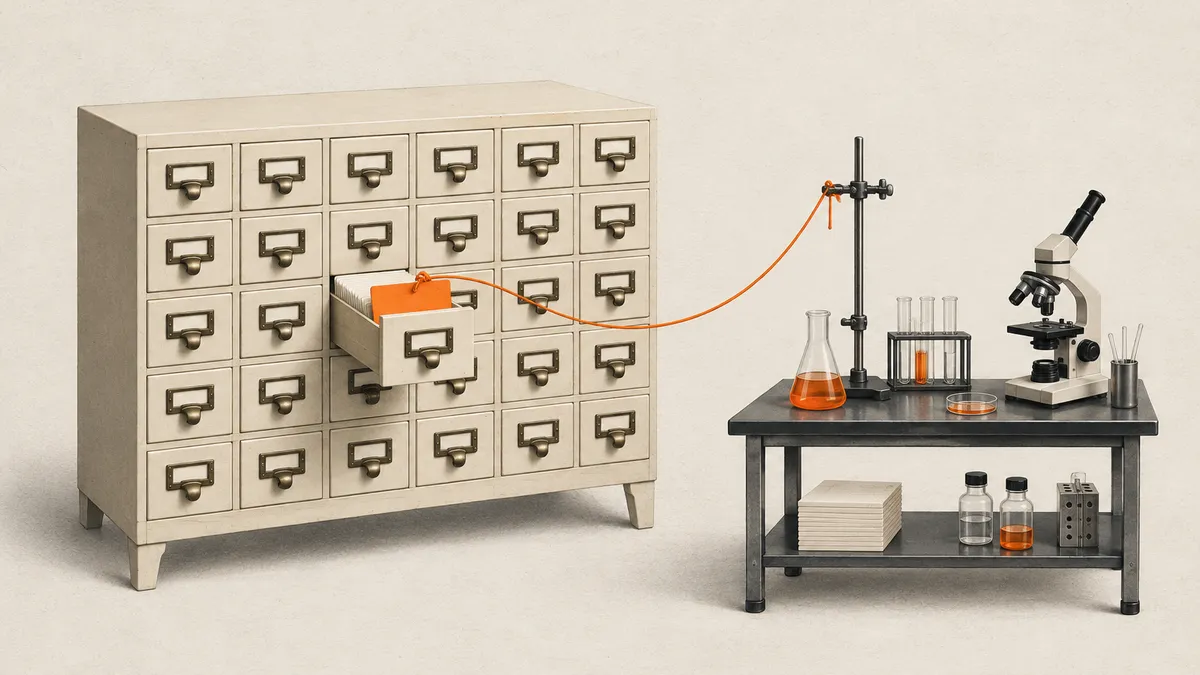
Finding an AI benchmark can be easier than working out what its score means. A paper submitted on September 10 introduces Benchmark Radar, a searchable catalog that keeps reported results connected to their sources. Its purpose is to help readers locate evidence across a fragmented evaluation landscape.
The strongest version of this project would help a reader ask a better question before choosing a model. The weakest would make a collection of scores look like a definitive ordering of intelligence. Those outcomes could start from the same records. The difference is whether the product preserves the conditions that give a result meaning or encourages users to treat every number as interchangeable evidence.
The authors report 1,283 source records collected from four catalogs. These are not 1,283 distinct standardized tests: separate sources can describe a related benchmark. The snapshot contains 12,916 numerical observations on 790 records, leaving 493 without scores. A count of observations is also different from a count of models.
More records do not mean more certainty
A catalog becomes easier to misunderstand as it becomes larger. A precise count gives an impression of coverage, but coverage is not the same as comparability. Several records might describe related evaluations under different conditions. Bringing those records together is useful work. The collection still needs to help readers distinguish independent evidence, alternative presentations and results that answer different questions.
Missing scores can also be informative. An entry without a result should not quietly acquire the appearance of a tested claim merely because it sits beside scored entries. Preserving that absence keeps the boundary of the evidence visible. A polished interface should resist the temptation to make every record look equally complete, because completeness of presentation would then conceal incompleteness of knowledge.
An index is a starting point
The system preserves source identities and score details rather than rerunning every model under common conditions. Its value therefore depends partly on whether a reader can follow a result back to the test that produced it. The paper says search precision, suitability for a user’s task and time saved have not been evaluated.
The conditions are part of the result
A score answers a question posed by an evaluation procedure. Change the task, inputs, resources or grading rules and the meaning of the answer can change with them. A search engine can help locate the procedure, but it cannot erase those distinctions by placing scores in adjacent rows. The most useful interface would bring the reader toward the conditions instead of inviting them to stop at the number.
That makes traceability a product feature with intellectual consequences. A reader who can follow a result back to its origin has a chance to discover whether it fits the decision at hand. A reader shown only a rank is being asked to trust choices that may be invisible. The catalog’s promise is strongest when it reduces the effort of checking those choices without pretending to make judgment unnecessary.
An earlier project illustrates the separate work involved in comparison. Stanford’s HELM research evaluated models on shared scenarios and metrics under standardized conditions, while publishing prompts and completions. That 2022 research provides context for the distinction; it does not validate Benchmark Radar or its current coverage.
The HELM comparison helps separate two contributions that are easy to conflate. Collecting evidence makes it easier to find. Running evaluations under shared conditions makes a particular comparison easier to interpret. Both can matter, but one does not automatically supply the other. A database should be credited for its own contribution rather than judged by a standard it did not claim to meet or promoted as if it had met it.
Consider a team choosing a model to extract information from invoices. A catalog entry might reveal a relevant test, but the team would still need to inspect its documents, answer rules and operating conditions. A high reported score would not establish performance on the team’s own invoices. This is an example of the evaluation work that follows discovery.
In the invoice example, a high result on an apparently relevant benchmark might justify further investigation. It would not settle whether the model handles the team’s document formats, missing fields or acceptable error rate. A useful search result would narrow the work needed to answer those questions. That is a meaningful role even if the final choice still requires a task-specific evaluation.
The authors’ unmeasured product claims deserve the same care as the scores being indexed. A larger catalog might save time, or it might require users to inspect more material before finding the right evidence. The way to distinguish those possibilities would be to observe people carrying out concrete research tasks. Until then, the credible description is a promising route to evidence, with practical usefulness still to be demonstrated.
Benchmark Radar points toward an evaluation culture that could become more accountable: show where the number came from, preserve what is missing and make incompatible conditions visible. That is a stronger ambition than producing another winner. The best benchmark search would leave users better equipped to challenge a score, not merely better supplied with scores to repeat.