
Google’s Finnish AI Bet Will Be Measured in Decades, Not Announcement Cycles
The infrastructure commitment comes with a much longer electricity agreement. Its significance lies in the obligations and choices that survive the construction headline.
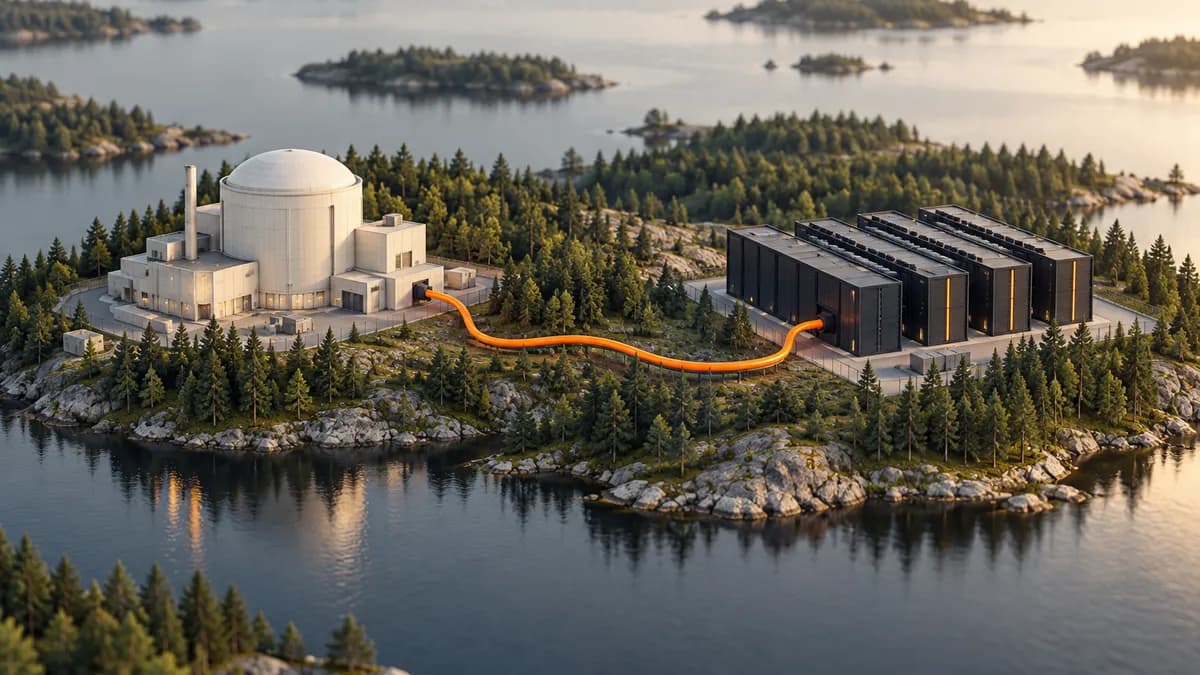
Google announced on September 9 that it plans to invest at least €13 billion in Finnish AI infrastructure during 2027 and 2028. The commitment covers data centers and supporting infrastructure across Hamina, Kajaani, Muhos and Vaala. The sum describes future investment, rather than an expenditure already completed.
The more revealing number is the duration of the power relationship. A two-year investment announcement describes a burst of planned activity. An agreement stretching across decades describes a business committing to an operating future. That is where the AI infrastructure story becomes an economic story about who gains certainty, who accepts obligations and which benefits extend beyond the companies signing the deal.
Alongside that plan, Finnish energy company Fortum announced a 22-year agreement to sell Google electricity from its Loviisa nuclear plant. Deliveries start at a smaller level in 2028, reaching half the plant’s capacity for 2030 through 2049. That is a much longer commitment than the two-year headline investment period.
Electricity makes the time horizon visible
A data center is useful only if it can operate, and electricity is part of that operating proposition. The supply agreement connects the ambition to build AI capacity with an existing energy asset and a long period of expected demand. It does not establish that every planned facility will proceed exactly as announced. It does show that the companies are arranging more than a short promotional partnership.
What the electricity agreement buys
Fortum says the revenue certainty supports investment needed to operate Loviisa for longer, with its licenses extending to 2050. The companies also signed a memorandum to explore further energy opportunities. An agreement to explore new nuclear power is different from a decision to build a new plant.
Predictable demand can be valuable to an energy producer considering investment in an existing plant. A committed buyer may make a future revenue stream easier to plan around. The buyer, in turn, can obtain a clearer foundation for its own operations. Those are plausible commercial benefits of the structure. They should be assessed separately from claims about what the arrangement will do for every other electricity customer.
The distinction between extending existing operations and exploring new nuclear capacity matters for the same reason. The first concerns an identified asset and an agreement. The second leaves substantial decisions ahead. Combining both into a single story of capacity already secured would make the announcement look more complete than it is. Investors and the public need to know which commitments exist and which possibilities are still being examined.
For the seller, a large long-term customer can make future revenue more predictable. For the buyer, a supply agreement supports planning for infrastructure expected to consume electricity over many years. The announcements do not disclose enough pricing detail to calculate who receives the better financial bargain.
Certainty for the parties is not a public benefit calculation
A long contract changes exposure to future conditions; it does not make those conditions disappear. The precise allocation depends on terms that the headline does not reveal. If demand, operating costs or market prices develop differently from expectations, the consequences for each party will depend on those terms. It would be a mistake to infer a complete picture of risk from the length of the agreement alone.
This is not an argument against long-term commitments. Large projects may be difficult to undertake without them. It is an argument for treating certainty as something with a beneficiary and a price, rather than an unqualified good. The same agreement can be attractive to both companies for different reasons. Understanding those reasons is more useful than assuming that their commercial logic automatically answers the public-interest question.
Fortum argues that the arrangement supports stability for Finnish electricity consumers. That is a claim about the wider benefits of the deal, not a promise that household bills will fall. A bilateral supply contract and a consumer’s eventual bill answer different questions; the release provides no calculation that resolves the latter.
For a household, the meaningful question would concern its own electricity costs and the reliability of supply. For a municipality, the relevant questions could include the obligations and lasting economic activity associated with a new facility. These are different accounts of value. An investment total does not combine them into a single answer, and the announcement does not provide enough information to settle them.
There is a timing problem as well. Announced investment, construction spending and sustained operations are separate stages. A commitment can be significant before money is spent, but its significance should not be described as an already realized result. Following what is actually built and operated will produce a more useful assessment than repeatedly quoting the original sum whenever the project reaches another milestone.
ITPro’s coverage situates the announcement in Finland’s growing role as a European data-center location. The useful measure of this particular expansion will be what gets built and how its power requirements are met. Google’s capital commitment and Fortum’s supply contract are substantial evidence of intent. They are not yet evidence of the finished infrastructure’s economic results.
Google’s commitment deserves attention because it links AI expansion to infrastructure with a much longer life than a model release. The next useful reporting should follow the obligations through that life: which facilities advance, how the energy arrangement supports them and what benefits become observable outside the contracting companies. The headline marks an intention. The economic verdict will depend on what that intention commits people and institutions to over time.